4-8-1
Approach Clearance
JO 7110.65BB, Change 3, effective July 9, 2026 · Official text on faa.gov
- Clear aircraft for “standard” or “special” instrument approach procedures only.
- To authorize a pilot to execute a particular instrument approach procedure:
- Specify the name of the approach as published on the approach chart.
- Where more than one procedure is published on a single chart and a specific procedure is to be flown, specify the approach to be flown.
- If only one instrument approach of a particular type is published, the approach need not be identified by the runway reference.
- An aircraft conducting an ILS or LDA approach must be advised at the time an approach clearance is issued when the glideslope is reported out of service, unless the title of the published approach procedure allows (for example, ILS or LOC Rwy 05).
- Instrument approach procedures (IAPs) must begin at an initial approach fix (IAF) or an intermediate fix (IF) if there is not an IAF.
- Where a STAR/ATS route and an IAP connect at an IAF or IF, and the connection will be used, clear the aircraft for approach at least 3 NM prior to the IAF/IF and specify the name of the connection fix. For arrivals via an ATS Route, assign an altitude to maintain until the connection fix.
- Where adequate radar coverage exists, radar facilities may vector aircraft to the final approach course in accordance with paragraph 5-9-1, Vectors to Final Approach Course, and paragraph 5-9-2, Final Approach Course Interception.
- Where adequate radar coverage exists, radar facilities may clear an aircraft to any fix 3 NM or more prior to the FAF, along the final approach course, at an intercept angle not greater than 30 degrees.
- Controllers must not disapprove a pilot request to cold temperature compensate in conjunction with the issuance of an approach clearance.
- To authorize a pilot to execute a particular instrument approach procedure:
- For aircraft operating on unpublished routes, issue the approach clearance only after the aircraft is:
- Established on a segment of a published route or instrument approach procedure, or (See FIG 4-8-1)
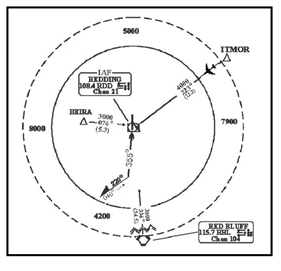
FIG 4-8-1 Approach Clearance Example - Assigned an altitude to maintain until the aircraft is established on a segment of a published route or instrument approach procedure. (See FIG 4-8-2.)
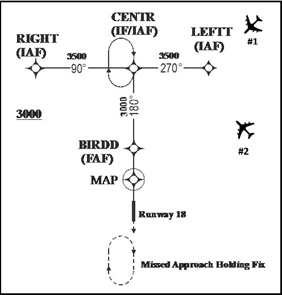
FIG 4-8-2 Approach Clearance Example
- Established on a segment of a published route or instrument approach procedure, or (See FIG 4-8-1)
- Except for visual approaches, do not clear an aircraft direct to the FAF unless it is also an IAF, wherein the aircraft is expected to execute the depicted procedure turn or hold-in-lieu of procedure turn.
- Intercept angles greater than 90 degrees may be used when a procedure turn, a hold-in-lieu of procedure turn pattern, or arrival holding is depicted and the pilot will execute the procedure.
- If a procedure turn, hold-in-lieu of procedure turn, or arrival holding pattern is depicted and the angle of intercept is 90 degrees or less, the aircraft must be instructed to conduct a straight-in approach if ATC does not want the pilot to execute a procedure turn or hold-in-lieu of procedure turn. (See FIG 4-8-3.)
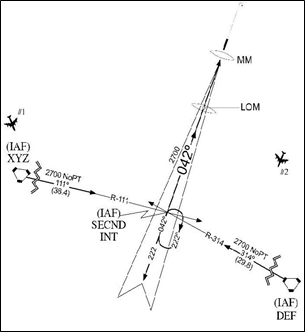
FIG 4-8-3 Approach Clearance Example For Aircraft On a Conventional Approach - Except when applying radar procedures, timed or visual approaches, clear an aircraft for an approach to an airport when the preceding aircraft has landed or canceled IFR flight plan.
- Where instrument approaches require radar monitoring and radar services are not available, do not use the phraseology “cleared approach,” which allows the pilot his/her choice of instrument approaches.
RNAV APPLICATION
- For RNAV-equipped aircraft operating on unpublished routes, issue approach clearance for conventional or RNAV SIAP including approaches with RF legs only after the aircraft is: (See FIG 4-8-4).
- Established on a heading or course direct to the IAF at an intercept angle not greater than 90 degrees and is assigned an altitude in accordance with b2. Radar monitoring is required to the IAF for RNAV (RNP) approaches when no hold-in-lieu of procedure turn is executed.
- Established on a heading or course direct to the IF at an angle not greater than 90 degrees, provided the following conditions are met:
- Assign an altitude in accordance with b2 that will permit a normal descent to the FAF.
- Radar monitoring is provided to the IF.
- The SIAP must identify the intermediate fix with the letters “IF.”
- For procedures where an IAF is published, the pilot is advised to expect clearance to the IF at least 5 miles from the fix.
- Established on a heading or course direct to a fix between the IF and FAF, at an intercept angle not greater than 30 degrees, and assigned an altitude in accordance with b2.
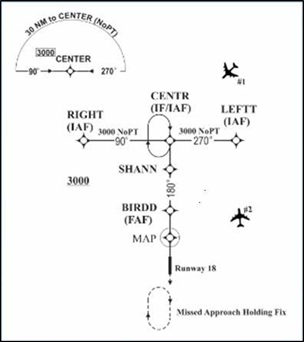
FIG 4-8-4 Approach Clearance Example
- Clear RNAV-equipped aircraft conducting RNAV instrument approach procedures that contain radius to fix (RF) legs:
- Via published transitions, or
- In accordance with subparagraph h.
- Do not clear aircraft direct to any waypoint beginning or within an RF leg.
- Do not assign fix/waypoint crossing speeds in excess of charted speed restrictions.
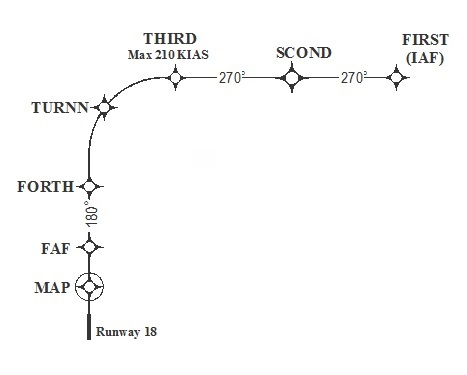
FIG 4-8-5 Radius to Fix (RF) and Track to Fix (TF)
- Where a terminal arrival area (TAA) has been established to support instrument approaches, use the procedures under subparagraph b above. (See FIG 4-8-6 and FIG 4-8-7.)
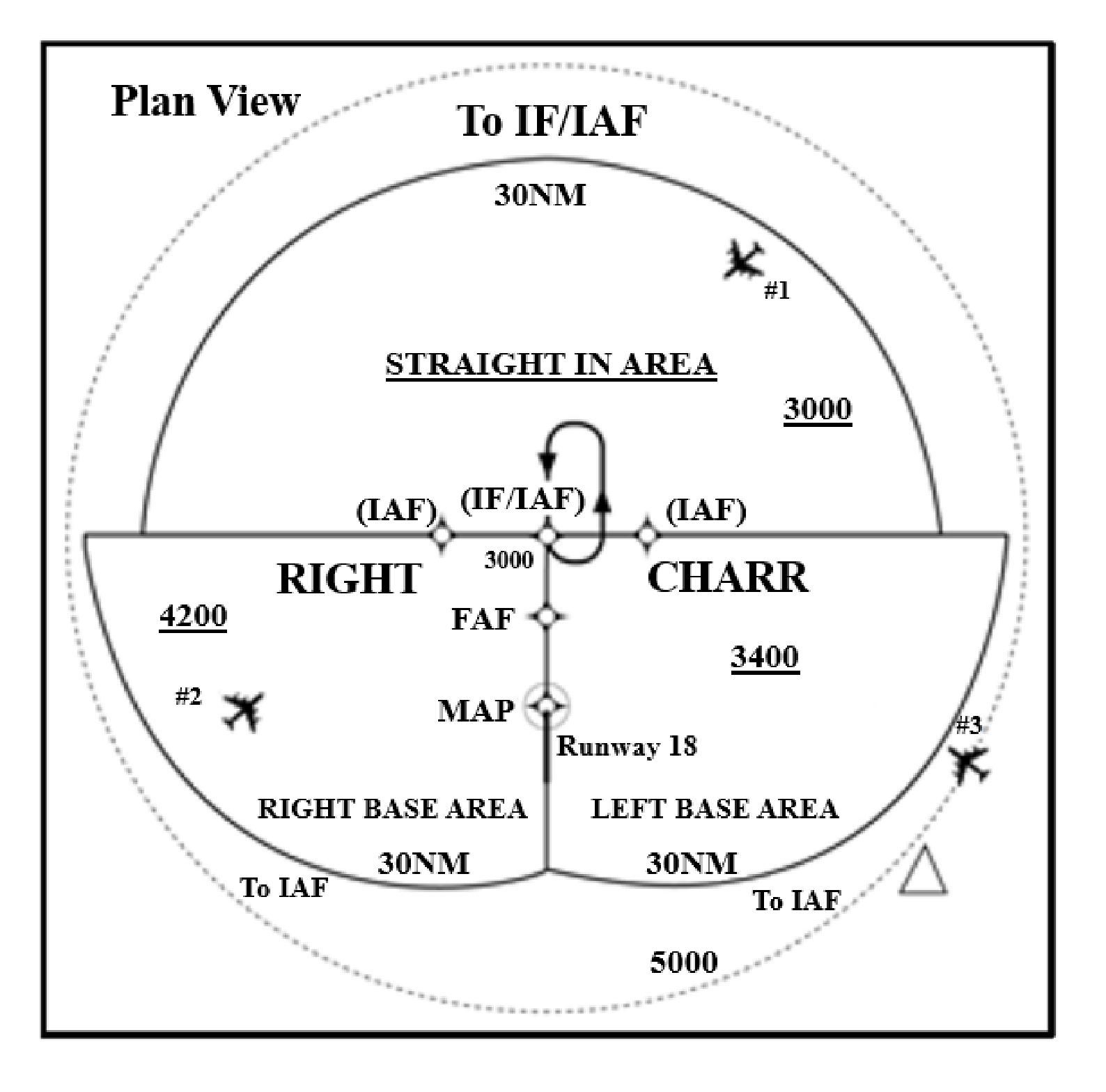
FIG 4-8-6 Basic “T" and TAA Design 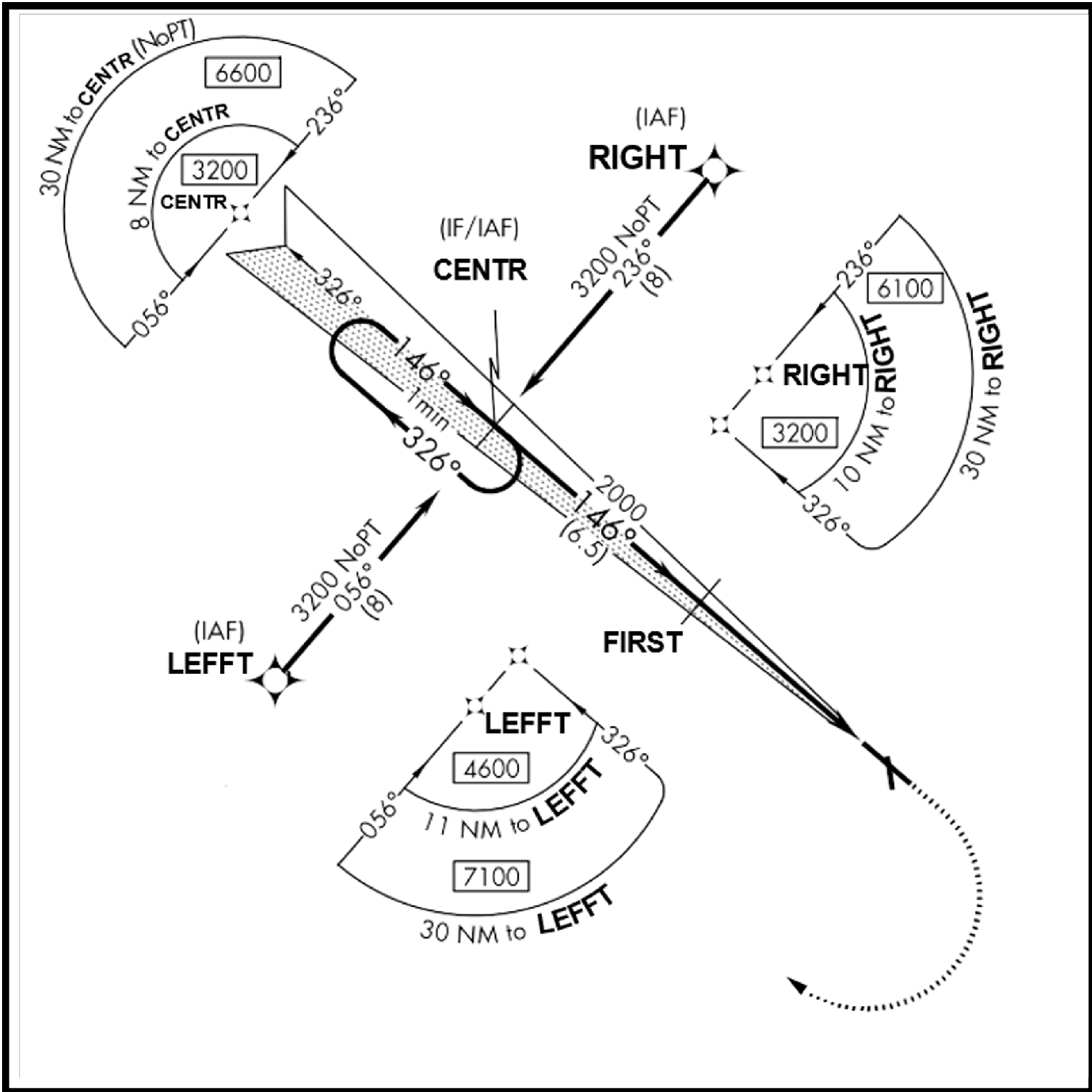
FIG 4-8-7 Basic “T” and TAA Design with ILS - When GPS TESTING NOTAMs are published and testing is actually occurring, inform pilots requesting or cleared for a RNAV approach that GPS may not be available and request intentions. Do not resume RNAV approach operations until certain that GPS interference is no longer a factor or such GPS testing exercise has ceased.
- During times when pilots report GPS anomalies, request the pilot's intentions and/or clear that aircraft for an alternative approach, if available and operational. Announce to other aircraft requesting an RNAV approach that GPS is reported unavailable and request intentions.
- When clearing an aircraft for an RNAV approach, and a GPS NOTAM is published (a WAAS NOTAM is not issued), both GPS and WAAS may become unavailable. Therefore, when a GPS anomaly is reported, request the pilot's intentions.