devriesc0801
Lurker
- Messages
- 12
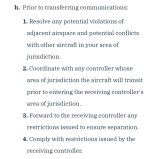
Do you apply h. 1. to aircraft and airspace for the "potential" turns when your LOA states that you release control for turns up to 30 degrees?


We have departure SIDs that diverge which means they have 5 miles lateral by the end of our airspace. Center has control for turns. Our LOA requires 5 miles longitudinal or lateral.If you ship me a guy, and I turn the guy 30 degrees in accordance with the LOA between our facilities, and that causes a loss with another guy you're talking to... that's your loss. Without question.
The LOA says I can do it, which means you gotta protect for me doing it.
5 miles lateral
5 miles
But you working terminal airspace don't have a loss until you bust 3, right? And I thought I heard that most/all centers can go down to 3 below FL230 now. So those scenarios aren't actual losses of separation.bare 5
Correct, and if the receiving controller took both handoffs and then turned the lead they are actively taking over their own separation of the aircraft. You just have to give 5, if you do that and then they turn them and make it 4, that's on them and probably even still legal for them as well.But you working terminal airspace don't have a loss until you bust 3, right? And I thought I heard that most/all centers can go down to 3 below FL230 now. So those scenarios aren't actual losses of separation.
If two aircraft end up with less than 3 (and no divergence), that is a deal and somebody needs to eat it. And it sure won't be the guy who operated in accordance with the LOA.
I guess I would clarify that if you turn them into my traffic then it's my loss but if you turn them 30° into your own traffic that's on you.If you ship me a guy, and I turn the guy 30 degrees in accordance with the LOA between our facilities, and that causes a loss with another guy you're talking to... that's your loss. Without question.
The LOA says I can do it, which means you gotta protect for me doing it.
You're right but regardless, if you can see the traffic on your scope and turn into it just because you can by the LOA that's trash controlling and not safe. Sure the other controller fucked up and should have ensured separation in accordance with the LOA but I'd see the controller that gave a turn into traffic getting a PROC as wellBut you working terminal airspace don't have a loss until you bust 3, right? And I thought I heard that most/all centers can go down to 3 below FL230 now. So those scenarios aren't actual losses of separation.
If two aircraft end up with less than 3 (and no divergence), that is a deal and somebody needs to eat it. And it sure won't be the guy who operated in accordance with the LOA.
I guess I would clarify that if you turn them into my traffic then it's my loss but if you turn them 30° into your own traffic that's on you.
Seems stupid to clarify that but I also figured it was a pretty simple rule to have a question about so idk
I see the aircraft conflict portion of this paragraph referenced a lot here, and most seem to be agree on its application. Do you all feel the same about the "potential violations of adjacent airspace" portion?I guess I would clarify that if you turn them into my traffic then it's my loss but if you turn them 30° into your own traffic that's on you.
Seems stupid to clarify that but I also figured it was a pretty simple rule to have a question about so idk
That one is a little different to me I guess. In general I'd say I get point outs for adjacent airspace if the track of the aircraft is going to take them through or close to a different sector than the receiving controller. If they turn the aircraft in accordance with the LOA and now they are going through a different airspace I hadn't got a point out for if probably call if I saw it but also if I get an aircraft and turn them towards another airspace then I'm calling that controller because I don't rely on the other controller to have seen where I was gonna put them.I see the aircraft conflict portion of this paragraph referenced a lot here, and most seem to be agree on its application. Do you all feel the same about the "potential violations of adjacent airspace" portion?
Not as strongly as I feel about the aircraft situation. I'm more in agreement with Gauff on this aspect of it.Do you all feel the same about the "potential violations of adjacent airspace" portion?
Completely agree with this view of it allNot as strongly as I feel about the aircraft situation. I'm more in agreement with Gauff on this aspect of it.
The receiving controller might not know about all of my aircraft. I could have someone no-transponder but still IFR, or whatever. I'm the only one who knows about them, so I need to protect for the potential turn when I ship someone to the next facility. Like Gauff said, it's poor controlling if that next controller turns into traffic they can see. But I don't KNOW that they can see my traffic.
An airspace boundary doesn't move, though (unless coordinated separately). It's always there. I feel like if the receiving controller wants to turn the aircraft into a fixed boundary, it's on them to coordinate that.
I would agree that if you dig down into it, the paragraph is the same for aircraft and airspace conflicts. But in practice I don't treat them exactly the same.
Not as strongly as I feel about the aircraft situation. I'm more in agreement with Gauff on this aspect of it.
The receiving controller might not know about all of my aircraft. I could have someone no-transponder but still IFR, or whatever. I'm the only one who knows about them, so I need to protect for the potential turn when I ship someone to the next facility. Like Gauff said, it's poor controlling if that next controller turns into traffic they can see. But I don't KNOW that they can see my traffic.
An airspace boundary doesn't move, though (unless coordinated separately). It's always there. I feel like if the receiving controller wants to turn the aircraft into a fixed boundary, it's on them to coordinate that.
I would agree that if you dig down into it, the paragraph is the same for aircraft and airspace conflicts. But in practice I don't treat them exactly the same.
Which is interesting, since the two sentences are worded the same way and in the same paragraph, but treated differently?Completely agree with this view of it all
I work a TRACON so when we do parachute jumping we give a point out or advisory on the altitude and area to all surrounding sectors and overlying sectors and they in turn avoid that area when shipping us aircraft. I'm also aware of neighboring MOAs when they are active and will avoid that with aircraft. We are also aware of TFRs that are taking place in neighboring sectors. None of that seems strange to not know.Do you all know all high, low, interior approach sector boundaries, shelves, etc. of your surrounding airspace? Do you all know the active tfrs, refueling tracks, military airspace etc. of surrounding sectors?
Its easy to only think about immediate corners and boundaries, but there can be a lot more going on that only you know internally to your sector at that time.
Just above we were discussing how far down the line you have to protect (once the aircraft is in the receiving controllers jurisdiction, this paragraph ends).
But if we now think about the other extreme, (handoff is made, accepted and shipped at the far reaches of the releasing / transferring sector), who is responsible for the conflicts in that area of jurisdiction?
I work a TRACON so when we do parachute jumping we give a point out or advisory on the altitude and area to all surrounding sectors and overlying sectors and they in turn avoid that area when shipping us aircraft. I'm also aware of neighboring MOAs when they are active and will avoid that with aircraft. We are also aware of TFRs that are taking place in neighboring sectors. None of that seems strange to not know.
Now say I get a point out from one facility about a plane switching to another facility and there is an active MOA or Jumping/Refueling etc, then I'm going to tell them "point out approved reference xxx" or I'll straight up ask them if they are aware of whatever activity taking place. It is your responsibility as the controller taking a point out to make sure the controller asking is aware of other conflicts whether that's traffic or a MOA or anything else.
Those things would only be an issue if you're saying that neither of the controllers are getting a point out with a controller whose airspace an aircraft is gonna be flying through and they have stuff going on. Also a point out can be denied too...
Your last paragraph goes straight to what you started asking about. The transfering controller is responsible to ensure there are no conflicts in their airspace prior to transferring the aircraft to the receiving controller. If there is a conflict with something I will initiate a handoff and call the receiving controller to point out a potential conflict if they are to turn the aircraft in accordance with the LOA, they take the handoff and it's now their responsibility no matter what the LOA says because they are aware of it.
We do, that's why you get point outs with airspace they can potentially fly through... That's it."Potential violations of airspace. . .
Potential conflicts with other aircraft in your area of jurisdiction"
It is a known fact, in this scenario, that as soon as you ship the aircraft you release control for turns up to 30 degrees.
Everyone seems to agree that they will protect this "potential" for other aircraft in their jurisdiction. How do we not feel the same about the "potential" for violations of airspace as the transferred aircraft leaves our area of jurisdiction in accordance with the LOA?


Because in practice it’s for temporary/near incursions. The rule doesn’t need to cover the next 50 miles and 3 sectors because responsibility will be transferred by that point.But in practice I don't treat them exactly the same.

