devriesc0801
Lurker
- Messages
- 12
Do you apply h. 1. to aircraft and airspace for the "potential" turns when your LOA states that you release control for turns up to 30 degrees?

One thing that gets me is we get it from approach and we don’t even know what positions is open sometimes or who is working what aircraft so it can get a little goofy to coordinate. I just use the technique of checking for traffic before I do anythingIf you turn an aircraft in to another sector's airspace, then it is your responsibility to do the point out. It's not on the person who released control to do your fucking job.
This is entirely different from them releasing control of an a/c that could be in conflict with another one of their a/c. Their job is separating their aircraft.
Right - how is this even a discussion.To explain my previous statement (though I agree there is some ambiguity in the way the paragraphs are written in the book)... we have had this question asked various times over the years and it has been clarified by higher ups from above the ARTCC level that the person issuing the clearance is the one responsible for doing the required coordination. If you do it before transferring the a/c, it's on you. If the receiving controller does it, it's on them regardless of LOAs/control release. In fact, one of the clarifications was specifically because people were doing the turning with LOA control and not doing point outs when they should have been.
I guess maybe I don't understand the .65, when you say its obviously the receiving controllers job to get point outs when the .65 says the exact opposite.If you turn an aircraft in to another sector's airspace, then it is your responsibility to do the point out. It's not on the person who released control to do your fucking job.
This is entirely different from them releasing control of an a/c that could be in conflict with another one of their a/c. Their job is separating their aircraft.
Such a simple answer that so many here seem to disagree with.Yes. That's what it says to do
Consider that you release full control to someone, not in an LOA, they just get control and you release it.I guess maybe I don't understand the .65, when you say its obviously the receiving controllers job to get point outs when the .65 says the exact opposite.
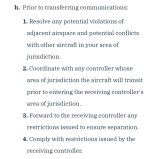
h. Prior to transferring communications:
1. Resolve any potential violations of adjacent airspace and potential conflicts with other aircraft in your area of jurisdiction.
2. Coordinate with any controller whose area of jurisdiction the aircraft will transit prior to entering the receiving controller’s area of jurisdiction.
...
j. After transferring communications, continue to comply with the requirements of subparagraphs h1 and h2
If my LOA says i have control for turns after communications transfer, the transfering controller should be able to expect me turning aircraft up to however far I have control to and be prepared to make pointouts as stated in h.2 and j. If the transferring controller cant protect what im afforded in our LOA, why not keep control of them and deliver them to me lower/further away from a boundary and follow h.1?
I'm for sectors working together and helping each other out, but if the receiving controller is repeatedly being forced into situations where they need to break multiple sector boundaries after handoff, maybe there is a systemic problem from the transfering controller not delivering them in workable places, or the LOA needs to be tighter to prevent transfer of control in such positions.
It actually does make sense that we should protect all aircraft and airspace from all KNOWN potential conflicts and airspace violations after completion of a handoff and communications transfer. To act like you have no idea what potential events may occur with a written agreement outlining the exact parameters and the exact point at which that control transfer occurs is a lazy excuse to not do your job.Consider that you release full control to someone, not in an LOA, they just get control and you release it.
Then consider how stupid it would be to have to point out that a/c to every possible other sector based on what the receiving controller could do any time you release control. What if they just randomly give a 120 degree turn in a completely unexpected direction? Should you have done that point out? What if they just descend them in to another sector? Should you have guessed that and done a point out?
Say you release control in an LOA, and IF they turned said a/c 30 degrees left, which would violate another sector, but normal ops would be them turning them to the right. Does it make sense that you have to point out every single a/c covered by that LOA to a sector that never actually gets violated?
The receiving sector knows what they are doing and are responsible for coordinating what they are doing if necessary. Fairly simple.
H1/H2 are referring to things you know they a/c is doing when you are the controlling sector. Once the receiving controller is the controlling sector, further new coordination is their responsibility. Anything else would require people to do endless nonsensical point outs every single time control is released.

This is absolutely correct. I’m repeating part of your point but any other interpretation would paralyze the system. You could not accept a call from any sector and release control without saying stand by I will call you back, calling every possible sector that any possible control action would affect and make vague point outs about what the receiving controller might do. If I key the mic and issue the control action, any coordination that results is my responsibility.Consider that you release full control to someone, not in an LOA, they just get control and you release it.
Then consider how stupid it would be to have to point out that a/c to every possible other sector based on what the receiving controller could do any time you release control. What if they just randomly give a 120 degree turn in a completely unexpected direction? Should you have done that point out? What if they just descend them in to another sector? Should you have guessed that and done a point out?
Say you release control in an LOA, and IF they turned said a/c 30 degrees left, which would violate another sector, but normal ops would be them turning them to the right. Does it make sense that you have to point out every single a/c covered by that LOA to a sector that never actually gets violated?
The receiving sector knows what they are doing and are responsible for coordinating what they are doing if necessary. Fairly simple.
H1/H2 are referring to things you know they a/c is doing when you are the controlling sector. Once the receiving controller is the controlling sector, further new coordination is their responsibility. Anything else would require people to do endless nonsensical point outs every single time control is released.
"Your control for turns up to 20 degrees right"This is absolutely correct. I’m repeating part of your point but any other interpretation would paralyze the system. You could not accept a call from any sector and release control without saying stand by I will call you back, calling every possible sector that any possible control action would affect and make vague point outs about what the receiving controller might do. If I key the mic and issue the control action, any coordination that results is my responsibility.
Please don't be a trainer everIt actually does make sense that we should protect all aircraft and airspace from all KNOWN potential conflicts and airspace violations after completion of a handoff and communications transfer. To act like you have no idea what potential events may occur with a written agreement outlining the exact parameters and the exact point at which that control transfer occurs is a lazy excuse to not do your job.
Your pointout and call for control example is irrelevant, since a handoff did not occur. This section is discussing the transferring controller's responsibilities for a radar handoff. Thats like using the radar section to control pattern traffic.
If we are unhappy protecting items that we give away in an LOA, then the LOA needs fixing, not the .65
Do people here give full control to controllers and pilots for everything any time it is asked? I guess I would too if I though it was someone else's job to do all the separation in my own airspace.
Handoff everyone and give away full control and im done cuz now its all their responsibility....... novel idea
Everyone should be a trainer it’s the only way you make what you deservePlease don't be a trainer ever


This is how it’s treated at my TRACON. If the aircraft is direct/on course to whatever is in their flight plan and isn’t going to be a conflict with airspace/traffic I ship them and the receiving controller is responsible for any potential conflicts/traffic since THEY turned them.If you turn an aircraft in to another sector's airspace, then it is your responsibility to do the point out. It's not on the person who released control to do your fucking job.
This is entirely different from them releasing control of an a/c that could be in conflict with another one of their a/c. Their job is separating their aircraft.
This would be "look and go". The "look" part is where you accept all responsibility for airspace and traffic in the other controllers area of jurisdiction vs whatever "go" clearance you are giving. An LOA is not needed if you are willing to accept this level of risk.This is how it’s treated at my TRACON. If the aircraft is direct/on course to whatever is in their flight plan and isn’t going to be a conflict with airspace/traffic I ship them and the receiving controller is responsible for any potential conflicts/traffic since THEY turned them.
Being a good neighbor as they say and using good judgement is a lot of this as well. I run aircraft somewhat tight because I’m comfortable with that, but not everyone may be, at least to the same degree. Handing off blatantly legal separation is the goal, but appeqing a heading or giving control always helps otherwise.
Correct. The receiving controller can turn them, but they’re responsible for any coordination required at that point as they’re the one taking the aircraft off their filed route.This would be "look and go". The "look" part is where you accept all responsibility for airspace and traffic in the other controllers area of jurisdiction vs whatever "go" clearance you are giving. An LOA is not needed if you are willing to accept this level of risk.
When there is no LOA giving away controller an no ther coordination is made, then the only thing left is flight plan route.
So if this is all that is expected, then why even create LOAs that give away control when "look and go" is the procedural responsibility? Just..... look and go anytime anywhere. And then you can say "I didn't expect him to turn him when I shipped him!"
Which is exactly the same thing you guys are saying, even when the LOA states that the receiving controller can turn him when you ship him.....
Right..... so no LOA or call needed.....just look.....and goCorrect. The receiving controller can turn them, but they’re responsible for any coordination required at that point as there the one taking the aircraft of their filed route.
What are you talking about he's literally saying there is an LOA that the receiving controller is allowed to turn them on contact up to a certain point. He's saying if they turn them and then create an airspace conflict at that point then the receiving controller is responsible for the point out because they created the situation.Right..... so no LOA or call needed.....just look.....and go
Even if the LOA gives away control to a receiving sector.....that receiving sector is still responsible for any and all "potential" separation that this control may impact.

