devriesc0801
Lurker
- Messages
- 12
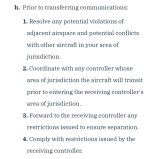
Do you apply h. 1. to aircraft and airspace for the "potential" turns when your LOA states that you release control for turns up to 30 degrees?


/threadIMO the .65 should be rewritten. If someone switches you and airplane they are your control and you are responsible for every control instruction that you issue.
In my 23 years I have never transferred communication of an aircraft to someone else that I didn't intend them to have control of. Why switch them if you don't want them to control them? Just keep them until you are ready for them to control the aircraft.
Same thing in reverse is true. If you ship me an aircraft I will absolutely issue the control instructions necessary. I am not calling you to ask for control, why? Because you shouldn't have transferred communication if you still wanted to control the aircraft.
The concept is really simple, the only person who can issue control instructions is the one talking to the aircraft. Therefore control is inherently theirs.
AW
I mean if it's in an LOA that you don't have control til a certain point then you straight up don't have control. I will switch center planes direct to the fix they are supposed to go while they are climbing and have other planes all around them but they are free of conflict on their route. Center doesn't have control for turns until they climb above my airspace, and if they did turn a plane they would most certainly cause a deal. Sure I could hold on to them until they are level at the top of my airspace and about to be out of the lateral boundary but the pilots want to climb and center wants to turn them so they can keep them climbing and then turn once they are above me.IMO the .65 should be rewritten. If someone switches you and airplane they are your control and you are responsible for every control instruction that you issue.
In my 23 years I have never transferred communication of an aircraft to someone else that I didn't intend them to have control of. Why switch them if you don't want them to control them? Just keep them until you are ready for them to control the aircraft.
Same thing in reverse is true. If you ship me an aircraft I will absolutely issue the control instructions necessary. I am not calling you to ask for control, why? Because you shouldn't have transferred communication if you still wanted to control the aircraft.
The concept is really simple, the only person who can issue control instructions is the one talking to the aircraft. Therefore control is inherently theirs.
AW
In stratified airspace you need the next controller to climb them out and into their sector. Making them level off is so dumb/thread
I'm not sure where you're getting the "handoff did not occur" from. My examples were all based on a handoff having been made and someone calling to get control after the a/c is shipped to them (or via LOA or whatever).It actually does make sense that we should protect all aircraft and airspace from all KNOWN potential conflicts and airspace violations after completion of a handoff and communications transfer. To act like you have no idea what potential events may occur with a written agreement outlining the exact parameters and the exact point at which that control transfer occurs is a lazy excuse to not do your job.
Your pointout and call for control example is irrelevant, since a handoff did not occur. This section is discussing the transferring controller's responsibilities for a radar handoff. Thats like using the radar section to control pattern traffic.
If we are unhappy protecting items that we give away in an LOA, then the LOA needs fixing, not the .65
Do people here give full control to controllers and pilots for everything any time it is asked? I guess I would too if I though it was someone else's job to do all the separation in my own airspace.
Handoff everyone and give away full control and im done cuz now its all their responsibility....... novel idea
I understand what you are saying it just stupid to write it that way. The .65 is inherently wrong on this subject. That's why you have to address it in an LOA. If the .65 was written the way that I described it, no LOA in any part of the country would have to address "transfer of control".I mean if it's in an LOA that you don't have control til a certain point then you straight up don't have control. I will switch center planes direct to the fix they are supposed to go while they are climbing and have other planes all around them but they are free of conflict on their route. Center doesn't have control for turns until they climb above my airspace, and if they did turn a plane they would most certainly cause a deal. Sure I could hold on to them until they are level at the top of my airspace and about to be out of the lateral boundary but the pilots want to climb and center wants to turn them so they can keep them climbing and then turn once they are above me.
So no transfer of communication does not constitute transfer of control at all
Holding on to everyone until there's no possible way anything could happen even if you haven't released control does cover your ass, but is also nonsensical protecting of other people doing illegal things. If they fuck up, that's on them. If everyone did this, as Gauff mentioned, everyone would be leveling off and doing other wasteful stuff for no reason.I understand what you are saying it just stupid to write it that way. The .65 is inherently wrong on this subject. That's why you have to address it in an LOA. If the .65 was written the way that I described it, no LOA in any part of the country would have to address "transfer of control".
My guess is, some idiot 50 years ago, while working non-radar routes named by colors (look it up, it was a thing) switched an aircraft to another idiot who also worked non-radar. The 1st idiot thought to themselves "the next guy probably isn't an idiot" so they switch the plane to the other guy who happened to also be an idiot.
2nd idiot was like "the guy that switched me this plane couldn't have been an idiot" so he did something idiotic.
While I grew up in ATC working terminal non-radar for days on end, that is not really a thing that happens anymore and if it does, the facility goes ATC zero and gives away airspace.
Fusion, ADSB and whatever center guys have basically eliminated this problem.
The most important point is don't switch an aircraft if you haven't eliminated all potential conflicts. Wait until the next sector/facility can in no way put two together.
Also, use your eyeballs and scan everything ahead before you open your mouth and issue a control instruction. And never issue an instruction if you can't explain why you issued it.
As I said in the last post, if you issue an instruction (even if the LOA says you have control) you and you alone are responsible for the airspace that you turn in to.
AW
It's come down through our facility in response to specific issues more than once, but I don't know if there's any nationally published document regarding it.Thats what im trying to find. The "official faa guidance".
Thank you. I brought this up on here vs the .65 wording since reading this section again has thrown me for a loop. Im definitely on board with "we operate this way", but placing that logically against the .65 wording did not sit well after reading it again. I wanted to see quality discussion on the black and white .65 wording and see where we got, not just "trust me bro"I understand what you are saying it just stupid to write it that way. The .65 is inherently wrong on this subject. That's why you have to address it in an LOA. If the .65 was written the way that I described it, no LOA in any part of the country would have to address "transfer of control".
My guess is, some idiot 50 years ago, while working non-radar routes named by colors (look it up, it was a thing) switched an aircraft to another idiot who also worked non-radar. The 1st idiot thought to themselves "the next guy probably isn't an idiot" so they switch the plane to the other guy who happened to also be an idiot.
2nd idiot was like "the guy that switched me this plane couldn't have been an idiot" so he did something idiotic.
While I grew up in ATC working terminal non-radar for days on end, that is not really a thing that happens anymore and if it does, the facility goes ATC zero and gives away airspace.
Fusion, ADSB and whatever center guys have basically eliminated this problem.
The most important point is don't switch an aircraft if you haven't eliminated all potential conflicts. Wait until the next sector/facility can in no way put two together.
Also, use your eyeballs and scan everything ahead before you open your mouth and issue a control instruction. And never issue an instruction if you can't explain why you issued it.
As I said in the last post, if you issue an instruction (even if the LOA says you have control) you and you alone are responsible for the airspace that you turn in to.
AW

The colored routes are still a thing. I have Amber, blue, green and red routes in my airspace now.I understand what you are saying it just stupid to write it that way. The .65 is inherently wrong on this subject. That's why you have to address it in an LOA. If the .65 was written the way that I described it, no LOA in any part of the country would have to address "transfer of control".
My guess is, some idiot 50 years ago, while working non-radar routes named by colors (look it up, it was a thing) switched an aircraft to another idiot who also worked non-radar. The 1st idiot thought to themselves "the next guy probably isn't an idiot" so they switch the plane to the other guy who happened to also be an idiot.
2nd idiot was like "the guy that switched me this plane couldn't have been an idiot" so he did something idiotic.
While I grew up in ATC working terminal non-radar for days on end, that is not really a thing that happens anymore and if it does, the facility goes ATC zero and gives away airspace.
Fusion, ADSB and whatever center guys have basically eliminated this problem.
The most important point is don't switch an aircraft if you haven't eliminated all potential conflicts. Wait until the next sector/facility can in no way put two together.
Also, use your eyeballs and scan everything ahead before you open your mouth and issue a control instruction. And never issue an instruction if you can't explain why you issued it.
As I said in the last post, if you issue an instruction (even if the LOA says you have control) you and you alone are responsible for the airspace that you turn in to.
AW
Off topic - so those routes through The Gulf that are Axxx,UAxxx,Lxxx and ULxxx they are read aloud as "Amber, Upper Amber, Lima, Upper Lima"?The colored routes are still a thing. I have Amber, blue, green and red routes in my airspace now.
We have every letter you can thing of. We just say the letter. Colored routes are between NDBs and are getting decommissioned fast. But the letter routes are usually just letter like ROMEO and then number and are RNAV routes. But some routes like NCA are just said NCA no phonetics.Off topic - so those routes through The Gulf that are Axxx,UAxxx,Lxxx and ULxxx they are read aloud as "Amber, Upper Amber, Lima, Upper Lima"?
Everyone in my landlocked area thinks I'm nuts when we give reroutes to Mexico
Depends on the controller here, some will say Blue 520, some say Bravo 520. The Limas and the Mikes are all phonetic though.Off topic - so those routes through The Gulf that are Axxx,UAxxx,Lxxx and ULxxx they are read aloud as "Amber, Upper Amber, Lima, Upper Lima"?
Everyone in my landlocked area thinks I'm nuts when we give reroutes to Mexico
I have eliminated potential conflicts because center doesn't have control for turns until they climb out of my airspace. Saying that they should have complete control on contact is beyond stupid and would require me to level every single commercial aircraft for 30 miles before I could switch them so that all conflicts are resolved when they would be way up in the flight levels normally.I understand what you are saying it just stupid to write it that way. The .65 is inherently wrong on this subject. That's why you have to address it in an LOA. If the .65 was written the way that I described it, no LOA in any part of the country would have to address "transfer of control".
My guess is, some idiot 50 years ago, while working non-radar routes named by colors (look it up, it was a thing) switched an aircraft to another idiot who also worked non-radar. The 1st idiot thought to themselves "the next guy probably isn't an idiot" so they switch the plane to the other guy who happened to also be an idiot.
2nd idiot was like "the guy that switched me this plane couldn't have been an idiot" so he did something idiotic.
While I grew up in ATC working terminal non-radar for days on end, that is not really a thing that happens anymore and if it does, the facility goes ATC zero and gives away airspace.
Fusion, ADSB and whatever center guys have basically eliminated this problem.
The most important point is don't switch an aircraft if you haven't eliminated all potential conflicts. Wait until the next sector/facility can in no way put two together.
Also, use your eyeballs and scan everything ahead before you open your mouth and issue a control instruction. And never issue an instruction if you can't explain why you issued it.
As I said in the last post, if you issue an instruction (even if the LOA says you have control) you and you alone are responsible for the airspace that you turn in to.
AW
Lmao insane take. Try doing that with another country and see what happens.If they are on my freq, they are my control

