The survivor benefit isn't a "fee." It's life insurance you buy with your pension, and here's the actual price tag.

FERS Ready

Member
Messages
5
branded-landscape.png
Talked through the survivor-benefit decision with a controller friend this week, and it's such a quietly huge one that I ran the whole thing in fersready.com to see it in real dollars.

Call her Dana. ATC, retiring at 52, married, high-3 about $165K. Her full pension before any election is $5,147 a month.

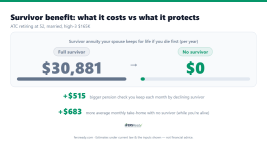
Elect full FERS survivor and OPM trims 10% off for life. Her check goes to $4,632 a month. That's $515 a month she gives up, for good.

In return: if she passes first, her spouse keeps $2,573 a month ($30,881 a year) for the rest of their life, with COLAs. Skip the survivor benefit and that number is $0 the day she dies. (And the spouse can lose FEHB coverage too, since staying on the plan is tied to receiving a survivor annuity.)

Here's the trap. While Dana's alive, "no survivor" always looks better. Across her retirement it's about $683 a month more take-home and roughly $319,825 more in total. But that whole surplus is only "ahead" if you ignore what happens to her spouse after she's gone. It isn't free money. It's the premium on a lifetime of survivor income.

I'm not telling anyone which way to go. Just this: run it in dollars before you sign, because the counter makes it sound like a small percentage, and it's really a six-figure decision. 🙏
Estimates based on current law and the inputs shown, not financial advice. Run your own numbers and confirm with OPM/SSA before making a decision.

Full worked reports, both elections:
Full survivor:
No survivor:

Did you take full, partial, or no survivor? And knowing what you know now, would you pick the same again?
 
View attachment 10270
Talked through the survivor-benefit decision with a controller friend this week, and it's such a quietly huge one that I ran the whole thing in fersready.com to see it in real dollars.

Call her Dana. ATC, retiring at 52, married, high-3 about $165K. Her full pension before any election is $5,147 a month.

Elect full FERS survivor and OPM trims 10% off for life. Her check goes to $4,632 a month. That's $515 a month she gives up, for good.

In return: if she passes first, her spouse keeps $2,573 a month ($30,881 a year) for the rest of their life, with COLAs. Skip the survivor benefit and that number is $0 the day she dies. (And the spouse can lose FEHB coverage too, since staying on the plan is tied to receiving a survivor annuity.)

Here's the trap. While Dana's alive, "no survivor" always looks better. Across her retirement it's about $683 a month more take-home and roughly $319,825 more in total. But that whole surplus is only "ahead" if you ignore what happens to her spouse after she's gone. It isn't free money. It's the premium on a lifetime of survivor income.

I'm not telling anyone which way to go. Just this: run it in dollars before you sign, because the counter makes it sound like a small percentage, and it's really a six-figure decision. 🙏
Estimates based on current law and the inputs shown, not financial advice. Run your own numbers and confirm with OPM/SSA before making a decision.

Full worked reports, both elections:
Full survivor:
No survivor:

Did you take full, partial, or no survivor? And knowing what you know now, would you pick the same again?
For my situation, I’m in favor of doing the partial survivor benefit, “split the difference.” Surviving spouse can keep their FEHB (huge in my situation) and they get some monetary benefit every month, and less taken off the annuity while you’re still alive.
 
So then when I am close to retirement, I should just get a quote for life insurance say for 30 year term. If it’s only 200 a month, then it’s a win. What yall think?
 
How so? Like they try to find some caveat not to pay out?
Less than 2% of life insurance policies pay out at a loss to the company. Most policies get so expensive over time that people cancel them, and the company made money for the decades they were collecting prior.

Don’t buy life insurance in retirement, it’s ludicrous expensive. If you die at 57? Then you should have basically the whole balance of your TSP left to leave to whoever. That’s like having huge life insurance for free.
 
So then when I am close to retirement, I should just get a quote for life insurance say for 30 year term. If it’s only 200 a month, then it’s a win. What yall think?
That's the right instinct, and "get a real quote before you decide" beats any rule of thumb. Two things worth thinking through though: what kind of policy, and what you need it to actually do.

Term vs whole, quick version:

  • Term is pure coverage for a set window (10/20/30 yr). Cheap, because most people outlive it and it pays nothing. No cash value, and when the term ends it's gone (renewing in your 80s costs a fortune).
  • Whole/permanent covers your entire life, so as long as you keep it up it will pay out whenever you go, and it builds cash value. It also costs many times more than term for the same death benefit.
The survivor annuity is closest to permanent: lifetime, COLA'd, your spouse can't outlive it. So a 30-year term isn't the same product. It's a bridge, not a permanent replacement, and that's fine as long as you treat it like one.

Here's the part I think people miss: life insurance isn't there to make your family rich when you die. It's there to cover the years they can't yet stand on their own. Early on the gap is huge (mortgage, kids, TSP still small). Over time it shrinks: house gets paid down, kids launch, TSP compounds, your spouse's own SS and savings grow. Eventually your assets are the safety net and you don't need the policy. A term that expires unused isn't wasted money, it means you reached the far side of the bridge and built the security yourself. That's the win.

So the real question for a $200/mo term isn't "is it cheaper than the $515 reduction." It's "will the bridge reach the shore." If you're confident your TSP plus your spouse's own income makes them self-sufficient before the term runs out, term-as-bridge can absolutely pencil out. If there's a real chance your spouse outlives both your assets and the term, that's exactly the tail the permanent survivor annuity is built to cover, and term won't.

Two footnotes: get the actual quote ($200/mo may be WAY optimistic for a big face amount at retirement age, health swings it a lot), and remember the one thing no policy fixes: drop the survivor annuity and your spouse loses FEHB for life. Insurance can't buy that back.

Honest bottom line: most policies never pay out, and that's the system working, people reached security another way. But for the families where it does pay, it's the difference between keeping the house and not. You're not buying a jackpot, you're buying a floor.

Curious what quotes folks have actually gotten near retirement age. Real numbers would help this whole thread.
 
Here's the part I think people miss: life insurance isn't there to make your family rich when you die. It's there to cover the years they can't yet stand on their own. Early on the gap is huge (mortgage, kids, TSP still small). Over time it shrinks: house gets paid down, kids launch, TSP compounds, your spouse's own SS and savings grow. Eventually your assets are the safety net and you don't need the policy. A term that expires unused isn't wasted money, it means you reached the far side of the bridge and built the security yourself. That's the win.
Excellent take right there. Buy term into your 50’s, then drop all life policies-too expensive. Your assets are the ‘safety net’ at that point in your life
 
Back
Top Bottom